
May 2024
Connections in Canberra's history: Territory Lease files and Canberra Community Hospital Board records
In April 2024, as part of the 41st Canberra and Region Heritage Festival, ArchivesACT took part in a panel discussion with several other cultural and heritage institutions—Canberra Museum and Gallery (CMAG), ACT Historic Places, and the ACT Heritage Library. Our aim was to reveal the connections between our institutions in terms of the material we hold. These records, objects, buildings and art works tell a story about Canberra as a unique community and a territory, distinct from the national capital and the national story.
Making a home in the fledgling National Capital (1920s and 1930s)
We selected the ACT Territory Lease Files to explore the physical beginnings of Canberra as a capital city. In 1913 when Lady Denman announced the name of the new capital, a new social experiment for the city was already underway. Nobody would own land in Canberra. It would be owned by the Commonwealth, and leased to those who wanted to use it. Australian politicians at this time were rather taken with American social philosopher Henry George’s idea that the value of land increases as a country develops, but not always due to the work of the landholder. The value increases because the city is growing, creating further demands. So why shouldn’t it belong to the whole community? Despite providing a way for the nation to build a new capital without spending taxpayer money, by 1920 only one federal MP remained a public supporter.
But the Federal Capital Commission continued with the great experiment. During the First World War, the freehold land in the ACT was acquired by the Commonwealth. In 1924, the Commonwealth was ready to issue Crown leases for the new suburbs.

Fig. 1. Examples of Territory Lease files
On 12 December 1924 the first auction sale of land leases for private housing was held in Canberra. The leases were for terms of 99 years and the rental was at the rate of five percent per annum on the assessed unimproved capital value for the initial twenty years. The lessee was required to begin building on the site within two years and finish within three years.
A Territory lease file was created for every block of land leased within the Federal Capital Territory. ArchivesACT makes information about many thousands of them available through our online database ACT Memory. The files comprise records relating to land matters, including surveys, acquisitions, leasing, improvements made, and disposal of land. In the early files, there is often correspondence about construction delays. Occasionally, building plans are also included.

Fig. 2. Examples of Territory Lease files
The files also show the responsibilities that lessees were given for maintaining the land and controlling pests and weeds. One report from the Property and Survey Branch on Dairy Block No 1 Canberra City District disclosed an investigation of a heavy growth of woolly thistle occurring on the block during 1930–1931, revealing that an Inspector Cox ‘desirous of preventing it spreading further came to an arrangement whereby three men of the Commonwealth were put to work, provided Mr Seller did the same’. The work was carried out on this basis, despite the report noting that ‘woolly thistle is not a noxious weed within the meaning of the Ordinance, never having been declared as such and that the Commonwealth had no power to enforce the destruction of this thistle by the Leasee’.
The Territory Lease files can be interesting and useful for tracking the history of a parcel of land and property, and access to them can be requested by the public. Where rural blocks have been subdivided, determining the current block and section number is not always easy. The ACTmapi tool, especially the Historic Plans feature, is indispensable, and ArchivesACT has some helpful resources too including Ted Griffiths’ report on ACT Rural leases in the 1970s.
Canberra accelerates: Boom time in the 1950s and 1960s
Australia’s population grew rapidly after the Second World War, due to both migration and births. This was also true in Canberra, as described by historian Jim Gibbney:
In the five years from 1946 to 1951, the Australian Capital Territory had by far the highest birth rate in Australia, with 41.11 per thousand, compared with the next highest figure of 25.11 for Tasmania. The territorial figure was actually almost double that of New South Wales, which recorded 21.72 per thousand. Although its inhabitants had to put up with the inevitable jokes about the absence of other diversions, the size of its juvenile population had to be taken seriously and the care of children both at school and before was a major concern.[i]
For comparison, the Australian Bureau of Statistic reported a birth rate of 11.6 per thousand in Australia in 2022.[ii]
Unsurprisingly, planners and administrators needed to focus on health care facilities and services as well as childcare and education. So, for this section of the Heritage Festival event, we looked at the Canberra Community Hospital Board records (ACT48). The Royal Canberra Hospital building at Acton is gone, and these records are some of its last visible traces. Like the Territory Lease files, these records document the administrative and organisational day-to-day business of a busy hospital and how it intersects with the social, cultural and personal worlds of Canberrans.
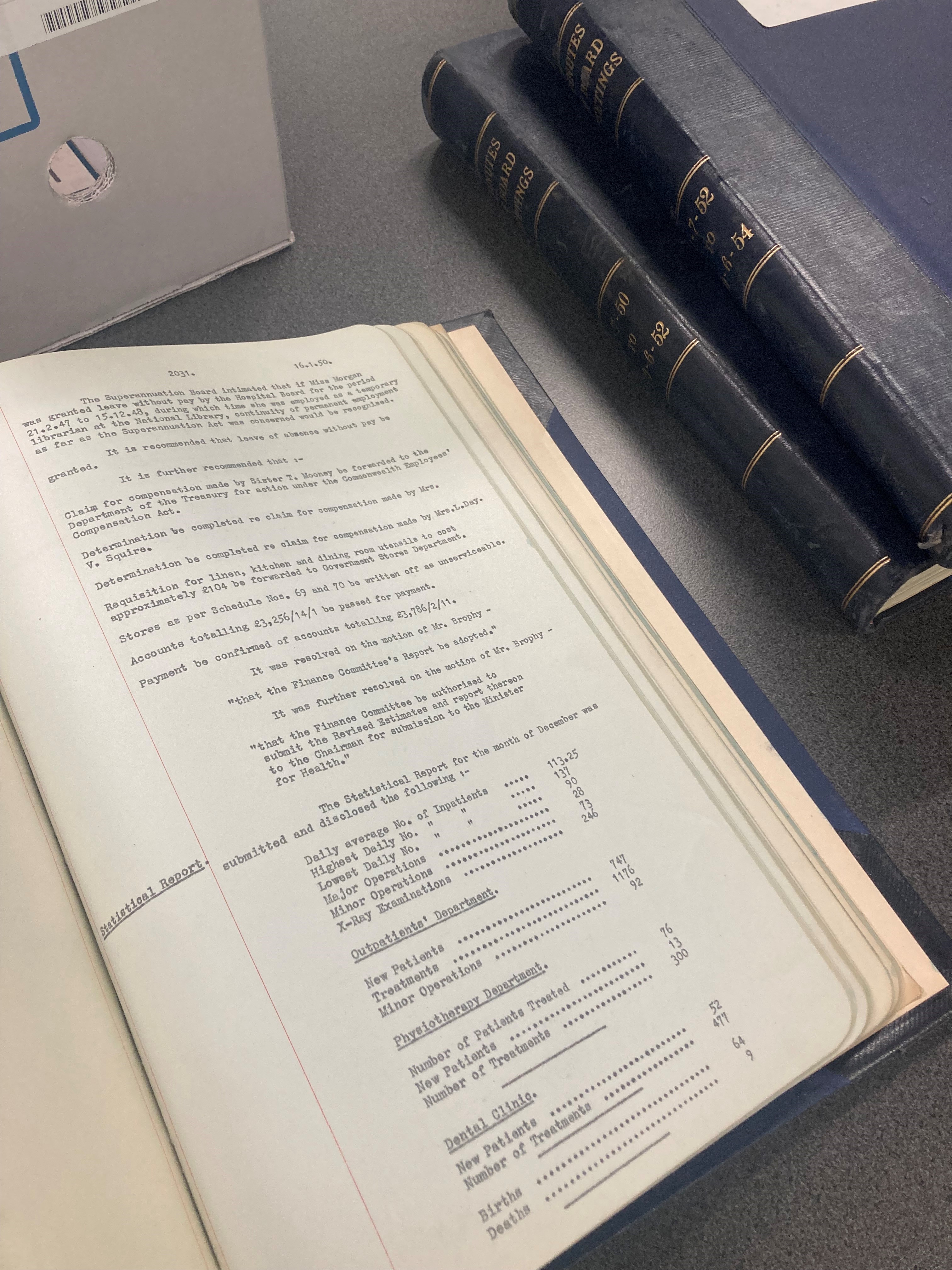
Fig. 3. Example of Canberra Community Hospital Board minutes

Fig. 4. Extract from Canberra Community Hospital Board minutes, 1960
The records show what was happening in the hospital, and the ambulance service, to a high degree of detail. For example, we see that in February 1960, there was an average of 194 inpatients at the hospital each day. The baby boom was still going strong, with 134 births at the hospital and four deaths.
There is also detailed information about overtime and staff movements. One theme that is striking to the contemporary reader is the limitations on women’s access to education and work at the time. Staffing reports record many resignations of female staff due to impending marriage. And in 1959, Matron reported that first, second- and third-year students would not be permitted to continue their training after marriage.

Fig. 5. Extract from Canberra Community Hospital Board minutes, 1959
The Canberra Community Hospital Board minutes also reflect the broader context of Commonwealth administration of the Federal Territory. The minutes record that Sir Earle Page, Minister for Health, and Dr A.J. Metcalfe, Director-General of Health attended the Board’s meeting at the hospital on 16 January 1950. Minister Page’s remarks to the Board are recorded in brief in the minutes, and in full in his own official papers held at the National Archives of Australia. He makes explicit reference to the special status for the Commonwealth being able to ‘do what it likes’ here, while also criticising the hospital’s poor record at attracting non-government funding, compared with NSW public hospitals.[iii]
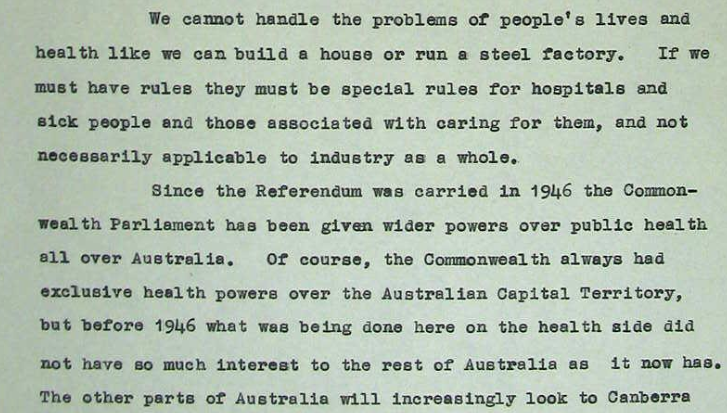
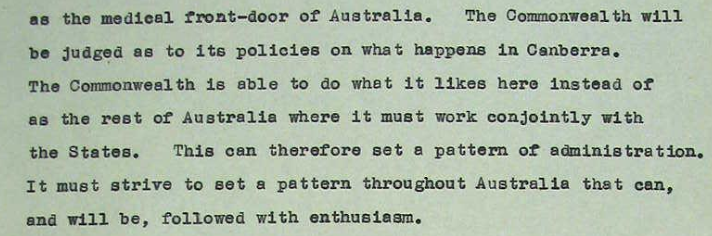
Figs. 6-7. Extracts from Earle Page's speech to the Canberra Community Hospital Board, Jan 1950
The theme of the 2024 Heritage Festival was ‘Connections’. Our shared event with CMAG, ACT Historic Places, and the ACT Heritage Library certainly provided an opportunity to demonstrate the connections between our institutions. It also reaffirmed for us the important connections that ACT Government archives can provide for our community, giving us all opportunities to see how events both everyday and momentous can help tell the story of Canberra.
Images
Fig. 1. Examples of Territory Lease files
Fig. 2. Examples of Territory Lease files
Fig. 3. Canberra Community Hospital Board minutes, ACT48
Fig 4. ACT48/CCHB15, p. 3247
Fig. 5. ACT48/CCHB15, p. 3226
Figs. 6 & 7. Extracts from Earle Page's speech to the Canberra Community Hospital Board, Jan 1950. National Archives of Australia, Personal Papers of Prime Minister Page, M4330/8
References
[i] : J. Gibbney, Canberra 1913-1953, Canberra 1988, p. 235
[ii] Australian Bureau of Statistics, Births, Australia 2022. https://www.abs.gov.au/statistics/people/population/births-australia/latest-release, accessed 1 May 2024
[ii] National Archives of Australia, Personal Papers of Prime Minister Page, M4330/8
Ready to start your own research?
Contact us through our Request a record - ArchivesACT and we will be happy to help.
File Readers/Viewers
If you do not already have compatible software on your computer, free file readers/viewers can be downloaded from the following links.
 PDF files require Adobe Acrobat Reader
 PPS files require Microsoft PowerPoint Viewer
 XLS files require Microsoft Excel Viewer